Burj Khalifa - Tallest Building In The World


Bringing Burj Khalifa to life required a combination of visionary ideals and solid science. In the process, the project amassed an awe-inspiring number of facts, figures, and statistics.

World Records
At over 828 metres (2,716.5 feet) and more than 160 stories, Burj Khalifa holds the following records:
  • Tallest building in the world
  • Tallest free-standing structure in the world
  • Highest number of stories in the world
  • Highest occupied floor in the world
  • Highest outdoor observation deck in the world
  • Elevator with the longest travel distance in the world
  • Tallest service elevator in the world

Tallest of the Supertall

Not only is Burj Khalifa the world’s tallest building, it has also broken two other impressive records: tallest structure, previously held by the KVLY-TV mast in Blanchard, North Dakota, and tallest free-standing structure, previously held by Toronto’s CN Tower. The Chicago-based Council on Tall Buildings and Urban Habitat (CTBUH) has established 3 criteria to determine what makes a tall building tall. Burj Khalifa wins by far in all three categories.
Height to architectural top
Height is measured from the level of the lowest, significant, open-air, pedestrian entrance to the architectural top of the building. This includes spires, but does not include antennae, signage, flagpoles or other functional-technical equipment. This measurement is the most widely used and is used to define the Council on Tall Buildings and Urban Habitat rankings of the Tallest Buildings in the World.
Highest occupied floor
Height is measured from the level of the lowest, significant, open-air, pedestrian entrance to the highest continually occupied floor within the building. Maintenance areas are not included.
Height to tip
Height is measured from the level of the lowest, significant, open-air, pedestrian entrance to the highest point of the building, irrespective of material or function of the highest element. This includes antennae, flagpoles, signage and other functional-technical equipment.

What to expect if you work in Dubai

What to expect if you work in Dubai
While the city is very much geared towards the business traveller, newcomers working in Dubai can be taken by surprise by some of Dubai's business customs.
The first thing to know about working in Dubai is that the working week can differ from business to business. The working week is generally Sunday to Thursday. However, retail and some other businesses open six days a week, closing on Fridays.
Usual business hours are from 08:00 to 13:00, resuming after the temperatures have begun to cool from 16:00 and continuing until 19:00. During Ramadan the working day may be shorter Free Zones may also have different working hours.
Peak traffic times are anything between 06:30-09:00 and 16:30-20:30. In the older part of town, peak times are from 13:00 until quite late into the night. Jams and accidents are a regular occurrence, and parking for some buildings may be a problem, so do take advice on how much time you should leave for your journey.

Business meetings

Working in Dubai can be very much in the regional manner and be very relaxed and informal, which is born of the whole hospitality / coffee culture. Similarly, you should allow plenty of time with all forms of paperwork, be they visa applications, government approvals or bank documentation.
The business dress code is conservative, and anyone working in more rural areas should wear clothing that completely covers the body. On the other hand, business meetings with Arab clients or colleagues can sometimes seem very informal and may take place in cafes (however, a pre-arranged business lunch can be extremely formal).
In business meetings, it is polite to enquire about families and make general conversation – the actual business part of the meeting can be quite short, with matters resolved very quickly. It is also acceptable for the client to take calls on their mobile phone.

Business etiquette

If you do need to criticise or correct someone, make sure it is in a private discussion away from the meeting, as causing public loss of face is considered very rude.
It is considered polite to have one side of your business card translated into Arabic, and to present this side of the card face up when passing it on to an Arab colleague or client.
One final thing to remember is that the more conservative Muslims often show their respect by not shaking hands with people of a different gender, so do wait for them to take the lead on hellos and goodbyes.

Dubai, UAE Information

GENERAL INFORMATION

FACT FILE

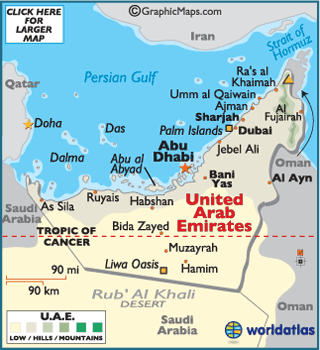
Dubai is one of the seven emirates that make up the United Arab Emirates and the name of the emirate’s main city. The modern emirate of Dubai was created with the formation of the United Arab Emirates in 1971.

Official Name: Dubai
Area: Total 4,114 km² (1,588.4 square miles)

Capital: Dubai (city of Dubai)
Currency: Arab Emirate Dirham (AED); 1 EUR = 5.4 AED
Official language: Arabic, but also widely spoken are Persian, Malayalam, English, Hindi, Urdu, Bengali, and Tagalog
Time zone: Dubai Standard Time (UTC+4)
Dialing Code: +971
Internet top-level domain (TLD): .ae
Emergency services: 999

Days of sunshine per year: 365
Average temperatures: December-March 24ºC; March-November 35 ºC

Main International Airports: Dubai International Airport (DXB), Maktoum International Airport (JXB) – under construction, to be ready in 2008

Religions: 96% Muslim, Hindu, Christian, 4% other
Government: Emirate
Emir: Sheikh Mohammed bin Rashid Al Maktoum

Population: metro 1, 492,000 (2006)
Population density: 345.65/km² (895.2/sq miles)
Gross Domestic Product (GDP): USD 46 billion (2006)

Business hours:

Government offices: Saturday - Wednesday (7:30am - 2:30pm)
General businesses work: 8am to 1pm and 4pm to 8pm from Saturday to Thursday
Banks: 8am to 1pm from Saturday to Wednesday and 8am to 12pm on Thursday

Most major credit cards are widely used and accepted.


Dubai is one of the wonders of the modern world. A decade ago the sand was the ruler of this emirate located on the edge of the Arabian desert with no discernible natural advantages. Nowadays the sand has been dethroned by the luxurious futuristic skyscrapers and the exclusive cozy villas scattered around the coastline. And all this is thanks to the vision of Dubai’s ruler – Sheikh Mohammed and the belief in his subjects in his idea to turn his country into the center of international trading and tourism. His logic is simple: if you build it, they will come.

The audacity of the city's ruler is breathtaking. Running out of coastline to build hotels? Build vast artificial islands with 120km of new beachfront. Need better connections with the world? Build up an award-winning international airline in 15 years.

From within these high standards of luxury and convenience, visitors can experience exotic Arabia in the bustling souks or a night in a Bedouin tent with belly-dancing under the starlit desert skies, as well as a way of life that is still embedded in the Islamic traditions of an ancient land. Dubai's attraction lies in the contrast between the ultra modern and the enchantingly traditional, which gives the city a personality like no other and visitors a variety of experiences to choose from. From desert oases and unspoiled beaches, camel races and old wind towers, to top-class shopping opportunities, avant-garde architecture and the finest international cuisine, Dubai has more than enough depth to satisfy even the most seasoned of travelers.

Places to see:

• Bastakiya District - historic home to many reconstructed buildings in the traditional style;
• Burj al-Arab hotel
• Dubai Museum
• Dubai Zoo
• Gold Souq
• Ibn Battuta Mall
• Jumeirah Mosque
• Mall of the Emirates
• Shindagha District
• Palm Islands

Warren Buffet's Investment Advice

Warren Buffet's Investment Advice

Warren Buffet
When it comes to the world of investments - especially in the stock market - Warren Buffet, the Chief Executive Officer of Berkshire Hathaway, is an enigma.

Celebrated as the "Oracle of Omaha" because of his unparalleled success in the stock market, Warren Buffet lives the life of your regular next-door neighbour, hardly eats in classy restaurants and drives a regular, used 4-wheel drive.

How is he able to maintain success for so many years? Here are some of his best advice. Hear him:

Stay liquid
"We will never become dependent on the kindness of strangers. We will always arrange our affairs so that any requirements for cash we may conceivably have will be dwarfed by our own liquidity. Moreover, that liquidity will be constantly refreshed by a gusher of earnings from our many and diverse businesses."

Buy when everyone else is selling
"We've put a lot of money to work during the chaos of the last two years. It's been an ideal period for investors: A climate of fear is their best friend.... Big opportunities come infrequently. When it's raining gold, reach for a bucket, not a thimble."

Don't buy when everyone else is buying
"Those who invest only when commentators are upbeat end up paying a heavy price for meaningless reassurance. The obvious corollary is to be patient. You can only buy when everyone else is selling if you have held your fire when everyone was buying."

Value, value, value
"In the end, what counts in investing is what you pay for a business -- through the purchase of a small piece of it in the stock market -- and what that business earns in the succeeding decade or two."

Don't get suckered by big growth stories
Buffett further reminded investors that he and Berkshire's Vice Chairman, Charlie Munger, "avoid businesses whose futures we can't evaluate, no matter how exciting their products may be."

Most investors who bet on the auto industry in 1910, planes in 1930 or TV makers in 1950 ended up losing their shirts, even though the products really did change the world. "Dramatic growth" doesn't always lead to high profit margins and returns on capital.

Understand what you own
"Investors, who buy and sell based upon media or analyst commentary are not for us.

"We want partners, who join us at Berkshire because they wish to make a long-term investment in a business they themselves understand and because it's one that follows policies with which they concur."

Defense beats offense
"Though we have lagged the S&P in some years that were positive for the market, we have consistently done better than the S&P in the 11 years during which it delivered negative results. In other words, our defense has been better than our offense, and that's likely to continue."

Hard work
All hard work bring a profit, but mere talk leads only to poverty.

Laziness
A sleeping lobster is carried away by the water current.

Earnings
Never depend on a single source of income. (At least make your Investments get you second earning)

Spending
If you buy things you don't need, you'll soon sell things you need.

Savings
Don't save what is left after spending; Spend what is left after saving.

Borrowings
The borrower becomes the lender's slave.

Accounting
It's no use carrying an umbrella, if your shoes are leaking.

Auditing
Beware of little expenses; A small leak can sink a large ship.

Risk-taking
Never test the depth of the river with both feet.(Have an alternate plan ready)

Investment
Don't put all your eggs in one basket.


General Investment Rules

  1. Rule Number 1 - Never lose money

  2. Rule Number 2 - Don't forget rule number 1

  3. You're neither right nor wrong because other people agree with you. You're right because your facts are right and your reasoning is right - and that's the only thing that makes you right.

  4. Risk comes from not knowing what you're doing. If you don't know jewelry, know the jeweler.

  5. If you don't feel comfortable owning something for 10 years, then don't own it for 10 minutes.

  6. There seems to be some perverse human characteristic that likes to make easy things difficult (Remember his advice to Bill Gates - keep it simple).

  7. One's objective should be to get it right, get it quick, get it out, and get it over... your problem won't improve with age.

  8. A public-opinion poll is no substitute for thought.

  9. It takes 20 years to build a reputation and five minutes to ruin it. If you think about that, you'll do things differently.

  10. "I never buy anything unless I can fill out on a piece of paper my reasons. I may be wrong, but I would know the answer to that. "I'm paying $32 billion today for the Coca Cola Company because..." If you can't answer that question, you shouldn't buy it. If you can answer that question, and you do it a few times, you'll make a lot of money.

  11. You ought to be able to explain why you're taking the job you're taking, why you're making the investment you're making, or whatever it may be. And if it can't stand applying pencil to paper, you'd better think it through some more. And if you can't write an intelligent answer to those questions, don't do it.

  12. Be fearful when others are greedy, be greedy when others are fearful.

Comparison Between Direct CDS and Nominees CDS Account

When opening a trading account with a Stock Broker (Participating Organization or Investment Banks) a CDS account will be opened at the same time. Normally, stock brokers can offer Direct CDS or Nominee CDS Account.
CDS stand for “Central Depository System” and it maintain by Bursa Malaysia Depository Sdn Bhd. Previously it was known as Malaysian Central Depository (“MCD”).
Each CDS account have its own advantage and disadvantage. The table below highlighted the different between the two.

CDS Account
DirectNominee
Account NameUnder shareholder name (eg Mr M)Under broker name ( eg HLG Nominee Tempatan for Mr M)
IPO applicationEligibleNot eligible
Paperwork on corporate exerciseHandle by shareholderHandle by stock broker (upon instruction). Broker may impose fees.
DividendSend to shareholderCredited to trust account with stock broker
Attending AGMEligibleNot Eligible (Possible but have to get stock broker to appoint as proxy)
Annual ReportMail to shareholderHave to request from broker
Share transferTo own or relative accountOnly to own account

By looking at the table above, it is clear that Direct CDS account have more advantage when compare to Nominee CDS account. The only advantage of Nominee CDS account is shareholder do not need to worry about paperwork on corporate exercise.

How to Open Trading and CDS Account for Trading in Bursa Malaysia?


In order for you to invest or trade shares that are listed in Bursa Malaysia, you need to open Trading Account and CDS Account. Below are the steps for you to follow.

Step 1 – Open trading account

You have to open trading accounts with stock broker or participating organization that is registered with Bursa Malaysia. You can find the list of stock broker companies at Bursa Malaysia webpage. You are recommended to visit their office to open an account so that their representative can verify your documents.

Some stock brokers allow account opening via internet but you need to get your documents certified by Notary Public.

Step 2 – Choose between Nominee or Direct Trading Account

Normally, stock broker provide two different trading account namely Nominee and Direct Trading Account.

For Nominee trading account, basically you appoint your broker to hold shares on your behalf. It means that, once you buy shares, your name will not show on the registration book of existing shareholders directly, instead it will show your Broker Name.

The advantage is, you do not need to do any paperworks such as fill up forms for bonus issue, right entitlements and others. The most important is your broker have to remember the dateline for all the paperworks, not you. But you still need to instruct them on what to do.

However, the disadvantage of nominee account are you are not eligible to apply for IPO and you may not receive the annual report or some gift vouchers easily.

Direct Trading account is exactly the opposite of Nominee Trading account.

You may choose to open nominee account with one broker and direct account with another broker.

Step 3 – Choose between Cash Upfront or Collateralised Account

Some brokers have an option for you to choose between Cash Upfront or Collateralised Account. For Cash Upfront account, total trading limit of the day is equal to the amount of cash you have in your trust account. The advantage of Cash Upfront account is lower brokerage fee.

For Collateralised Account, you are allowed to trade beyond the amount of cash that you have in trust account. Normally, broker allows at least 2 times the amount cash that you have. On top of that, if you have shares in the attached CDS account, they also can be used as collateral to increase your trading limit.

Trust account is an account where your broker keep cash that you deposited. They may pay interest on the money keep in this account.

Step 4 – Decide to invest Online or Offline

To invest or trade in Bursa Malaysia you can have either do it via Offline or Online but now, most of the brokers in Malaysia provide online trading platform.

For Offline Trading account, you will have a real people called remiser who will handle all your orders. You will have to contact your remiser through what ever means for buy or sell shares.

For Online Trading Account, all of your orders are made through internet application which nomally load through internet browser of your computer. Some stock broker also allow to do transaction via PDA phone or mobile phone.

The main advantage of Online trading Account over Offline Trading account is lower brokerage fee. For online trading account, you may call helpdesk for trading but they may impose high brokerage fee.

You can look at the list of stock broker companies that offering online trading here.

Step 5 – Open Central Depository System (CDS) account

Next, you have to open CDS account. Your chosen Stock Broker will assist you to open CDS account.

CDS account is an electronic account which maintain by Bursa Depository or formerly known as Malaysian Central Depository.

CDS account is used to keep track or your shares or stocks movement. Shares will be credited to your account when you buy and debited from your account when you sell on due date.

You need to fill and sign in CDS Opening Account Form (FMN01). At the same time you have to sign two copies of specimen cards and provide copies of your identity card (NRIC).  The fee for CDS account openning is RM10.

If you have multiple trading account, you have to open separate CDS account for each trading account. Sharing CDS account is not allowed.


Braised Spicy Pumpkin


Ingredients

·         1 medium Japanese pumpkin, 2lb
·         4 oz minced pork or beef
·         2 tbsp dried shrimp, soaked until soft
·         1/2 tbsp spicy Sichuan bean paste
·         2 slice ginger
·         2 tbsp soy sauce
·         2 tbsp cooking wine
·         1 cup stock/water
·         Chopped scallions

Instructions

1.       Cut the pumpkin into 1.5x1.5 cubes with the skin attached.
2.       In a wok, heat up 2 tbsp of oil. Fry the ginger until brown. Add the minced the pork, dried shrimp, and the cooking wine. Cook until the pork turns color. Add cubes of pumpkin.
3.       Stir the pumpkin to mix with the meat and shrimp. Add stock/water, Sichuan bean paste, and soy sauce. Mix well.
4.       Bring to boil and simmer in low heat to your tenderness. Stir to mix periodically to make sure the pumpkin cubes are cooked evenly.
5.       I like my pumpkin soft but not completely mush so I normally simmer for about 6 minutes. If you like it really soft, cook it for about 10 – 12 minutes. Garnish with some freshly chopped scallions